
These are a few of my writings. If I were to run a thread through all of my writing it is a curiosity about the broader politics of knowledge as it impinges on diverse disciplines and intellectual constructs.


authored
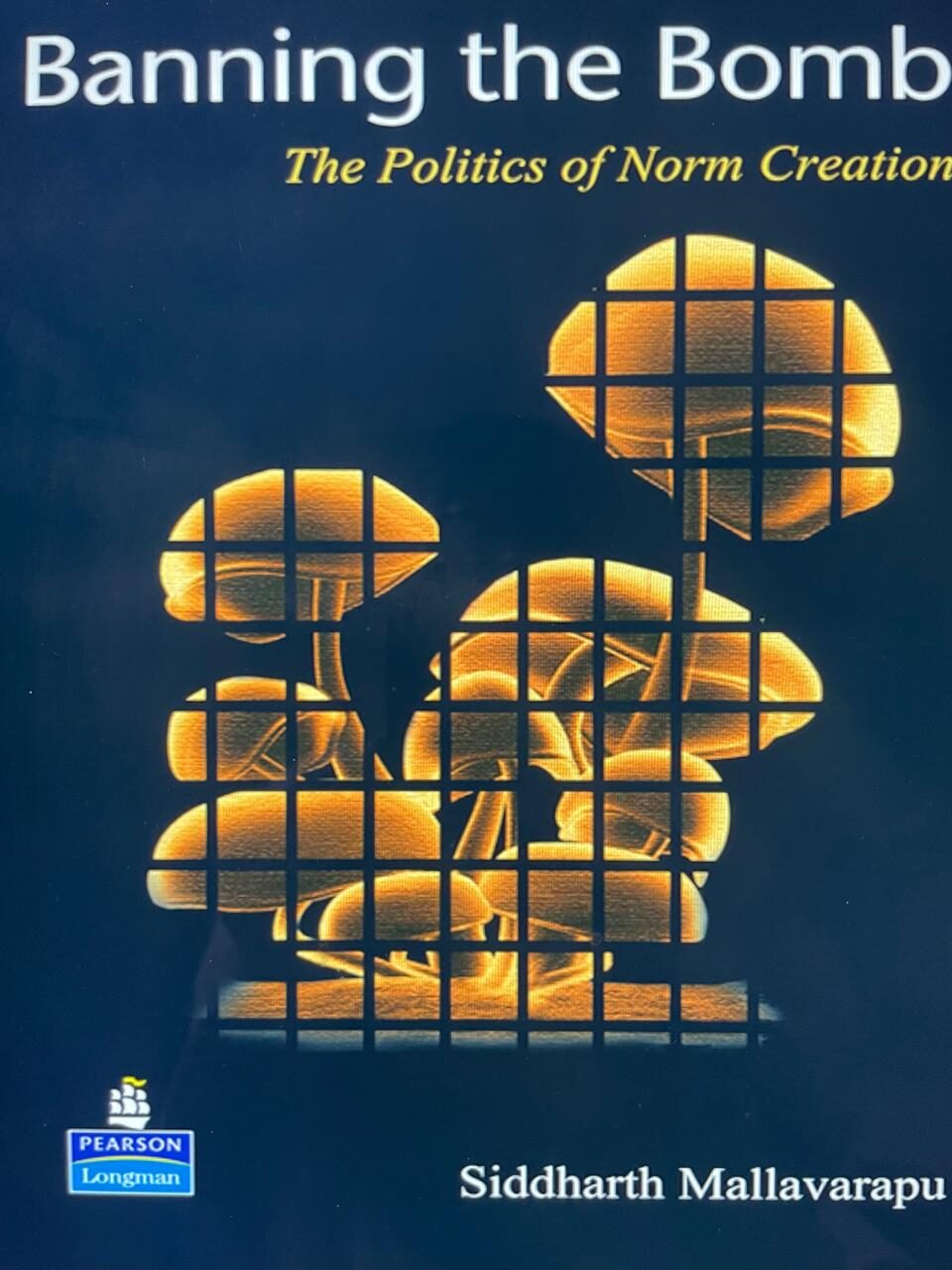
Banning the Bomb
The Politics of Norm Creation
This is my first single author book which morphed over time from an initial doctoral thesis defended in 2004 to a subsequent book published by Pearson Longman in 2007. The book is available now on Kindle as well.
I thoroughly enjoyed working on this project and the opening paragraphs of Prof.B.S.Chimni’s ‘Foreword’ captures with his characteristic accuracy and lucidity the broad sensibilities and concerns that animated my study.
Siddharth Mallavarapu has written a brilliant book on a subject of crucial interest to the global peace movement – the legality of the threat or use of nuclear weapons. The book is written in elegant prose. It captures with acumen the theoretical contestations relating to the politics of norm creation through analyzing the events leading up to the seeking of the Advisory Opinion of the International Court of Justice (ICJ) by the United Nations General Assembly (UNGA) and the subsequent opinion of the Court in the Legality of the Threat or Use of Nuclear Weapons case.
Mallavarapu frames his arguments in the matrix of the general debate between structural realists, with their emphasis on power, and constructivists, with their stress on the ideational element in international relations. His contention is that the constructivist approach to international relations offers a more insightful account of the politics of norm creation. The World Court Project that persuaded UN member states to seek the advisory opinion of the ICJ on the legality of the threat or use of nuclear weapons was after all the initiative of non-state actors. The enterprise showed how the consistent espousal of an idea, in this case the need to delegitimize nuclear weapons, can transform normative space.
co-edited
International Relations in India
Bringing Theory Back Home
With Kanti Bajpai
Two co-edited anthologies (2005) by Kanti Bajpai and I preceded my first single author book, Banning the Bomb: The Politics of Norm Creation. It was wonderful for me to collaborate with my doctoral mentor on this project. Bajpai recognized the need to systematically assemble and consolidate important slices of theoretical engagement in the sphere of international relations in the Indian context. His course on International Relations theory had a section on Indian thinking in International Relations and this book built on many of those early instincts in identifying the need to build a corpus of something robust and worthwhile here.
International Relations in India Bringing Theory Back Home was the first of the two volumes that was published. It was followed by International Relations in India: Theorising the Region and Nation in the same year 2005. The subtitle of the first book borrows from one of Bajpai’s earlier interventions. It also appears in the anthology immediately after an introduction to the collection in volume one.
As a conscious departure from Anglo-American ethnocentrism which remained then (and in many ways still today) the mainstay of the discipline, we worked hard as suggested in the introduction to ‘…forge an intellectual collective from within, committed to enlarging the boundaries of International Relations theory in India.’ If there is one collection that should stand the test of time for anybody curious about the theoretical conversations in international relations from an Indian provenance, we believe that this anthology and its companion volume will in some ways be indispensable to any serious disciplinary stock-taking.
Contributions to this volume include specific pieces by A.P.Rana, K.P.Misra, B.S.Chimni, Rajen Harshe, A.K.Ramakrishnan, Anuradha M.Chenoy, Sabyasachi Basu Ray Chaudhury, Rahul Mukherji, Ranabir Sammadar, Achin Vanaik, Rajesh Basrur, Shibashis Chatterjee and M.S.John apart from the co-editors themselves. The volume also covered a wide range of themes. These included the challenges that faced the Indian context when it came to instituting International Studies in India, how states were implicated in modern national projects in postcolonial settings, the challenge of building community in the Indian variant of International Relations (IR), two pieces on Marxism, the first of how it manifest in the sphere of international law and the second a Gramscian reading of imperialism.
Besides these pieces, there were chapters on orientalism and what it meant for postcolonial IR scholarship in India, conceptual dilemmas around human security, the role of gender in thinking about national security, economic sanctions as a device of foreign policy, human rights, the challenges of securing peace, systemic duality and realism, structure and interaction in the world system, a re-evaluation of other versions of realism and its relationship to critical theory and finally a reassessment of the state as a major category in IR. It’s catholicity was evident both in theoretical and empirical terms.
co-edited
International Relations in India
Theorizing the Region and Nation
With Kanti Bajpai
This companion volume is a continuation of the anthology initiated in the opening volume titled International Relations in India: Bringing Theory Back Home. In terms of its contributors, it brings together a wide ensemble of authors of diverse theoretical persuasions. Kanti Bajpai wrote the introduction here while I authored the introduction to the earlier co-edited volume. Contributors included A.P.Rana, Ashis Nandy, Jadgish K.Patnaik, Dawa Norbu, Deepa M.Ollapally, Rajesh Rajagopalan, Sushil Kumar, Bhupinder Brar, Sanjay Chaturvedi, Samir Kumar Das, Paula Banarjee and Ranabir Sammadar.
The themes here are eclectic from an evaluation of international conflict and how it is viewed in the global south, an excavation of a subterranean realism in Indian political culture, a perspective from the developing world on International Political Economy (IPE), a dissection of elite beliefs against the backdrop of nationalism, state interests and world politics, debates between realists and culturalists on foreign policy and identity politics, a neorealist reading of the Indo-Pak conflict, a reconsideration of security narratives in South Asia, non-alignment and critical geopolitics plotted against the backdrop of a colonial legacy, the perils of ethnic sub-territoriality, the fluid nature of political boundaries and the limits of territoriality were all treated as par for the course in terms of theoretical reflection.
As I write this entry in 2025, I notice that exactly two years have transpired since this initial effort. I have had the opportunity more recently to re-read both parts of the anthology and was gladdened to recognize that they still have analytical purchase in terms of theoretically grappling with a series of enduring political questions that have not exhausted themselves either in terms of their implications or in terms of our understanding both in our immediate region and the world at large.
This collective endeavour has resulted in a sustained and ongoing conversation now coalescing more around India’s internationalist and strategic thought. In 2019, Bajpai and I produced another volume titled, India, the West and International Order published by Orient Blackswan. I shall offer a thumbnail account of this effort a little ahead.
co-edited
International Relations in India
Perspectives for the Global South
With B.S.Chimni
B.S.Chimni and I co-edited this book in 2012 for Pearson publishers. The intent was to develop a comprehensive textbook of International Relations (IR) for students particularly in the global south. It is meant to be a resource for teachers considering it covers themes that are often sidelined in mainstream Anglo-American 101 introductions to IR. Entries on colonialism, imperialism, race, class, gender, Indian thinking in international relations, global finance, Gandhi and his imprint on world politics are less likely to find currency in canonical textbooks of IR. We also reached out to some fine scholars from around the world. Naeem Inayatullah, David Blaney, Himadeep Muppidi, Michael Barnett, Thomas Weber, Clive Archer, Rahul Rao, Yudhishthir Raj Isar and Stephen Castles were among several others contributors to this endeavour.
What began as a set of preliminary conversations between Chimni and I eventually culminated in this book. We dedicated this effort and its outcome to the School of International Studies at Jawaharlal Nehru University. The introduction was jointly co-authored by us and went through several iterations before we were satisfied with the outcome. Chimni contributed two other fine pieces in this collection, one on ‘class’ and the other on ‘international law’.
Apart from mapping the theoretical landscape, I particularly enjoyed working on an early piece on disciplinary history titled ‘Indian thinking in International Relations’. This along with two other contributions, the first in the titled ‘The Sociology of International Relations in India’ in an edited volume of Gunther Hellmann titled Theorizing Global Order and the other titled ‘Theorizing India’s Foreign Relations’ in The Oxford Handbook of Indian Foreign Policy co-edited by David M.Malone, C.Raja Mohan and Srinath Raghavan were conscious disciplinary history of Indian IR interventions made by me. The piece titled ‘Development of International Relations Theory in India’ that appeared in International Studies could be added as a further exploration of this sensibility which remains integral to my core set of intellectual commitments.
Both Chimni and I are glad that we made an effort in International Relations: Perspectives for the Global South in the direction of providing contextually rich and accessible material to students embarking on the study of IR in India and potentially anywhere in the global South. We also feel that this is a useful resource for teachers interested in offering 101 introductory courses to IR given the wide range of issues covered as well as the quality of inputs from authors who contributed. We hope it is put to use widely by both students and teachers especially in the global South though by no means necessarily confined to it.
co-edited
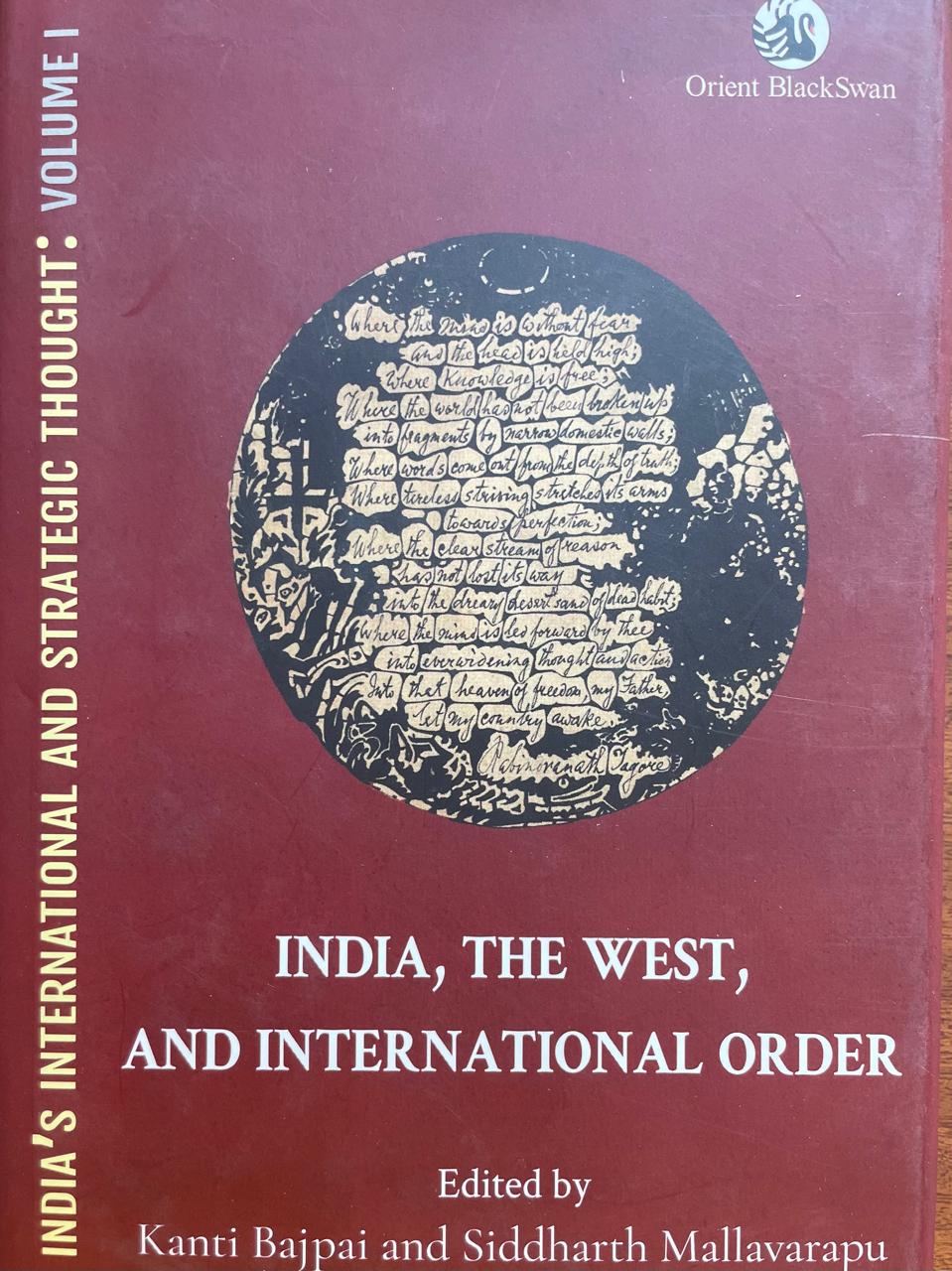
India, the West, and International Order
With Kanti Bajpai
In 2019, Kanti Bajpai and I co-edited India, the West, and International Order which was published by Orient Blackswan. The canvas of India’s internationalist thought extended from ‘…the late 19th to the middle of the 20th century’ and we covered seven thinkers with select extracts. These include Swami Vivekananda (1863-1902), Gopal Krishna Gokhale (1866-1915) , Rabindranath Tagore (1861-1941), Mohandas Karamchand Gandhi (1869-1948), Vinayak Damodar Savarkar (1883-1966), Madhav Sadhashiv Golwalkar (1906-1973) and Sayyid Abdul A’la Maududi (1903-1979). The two Europeans who were featured were Sister Nivedita (1866-1915) and Annie Besant (1847-1933).
We co-authored a long introduction which set the tone and context for this intellectual history and also provided the rationale for the selection of thinkers and the choice of extracts. This work is now extending further as envisaged in our original ideation. Apart from focusing only on India’s International Thought, we also make a strong case for adequately representing India’s Strategic Thought. The eventual double volume will we hope be a foundational resource for anyone wishing to research and teach around India’s International and Strategic Thought going ahead.
As we slowly but surely depart from a purely Anglo-American account of the discipline, the curricula for the study of IR is also evolving in India. It allows for more diverse sources to be treated as an integral part of the warp and weave of international relations. The spate of recent biographies of figures who contributed to India’s diplomatic life overseas testifies to the burgeoning nature of this area of inquiry. There is scope for more of these accounts which participate in a global conversation. Two illustrative stellar recent biographies that come to mind are Manu Bhagvan’s account of Vijaya Lakshmi Pandit and Narayani Basu’s account of K.M.Panikkar.
Chapters and Articles
Review Articles
‘The World as Viewed from China: Theorizing Governance, Leadership and Relationality
in the 21st Century’, China Report, 2020; Vol.56, No.1, pp.129-138.
- ‘Confronting Death: Doctors on Mortality’, Himal Southasian, online: <http://himalmag.com/confronting-death-doctors-on-mortality/?currentPage=all> 27 April, 2016. Last accessed on 14 June, 2016.
- Anindya Saha and Siddharth Mallavarapu, ‘State Weakness and State Failure: Genesis and Consequences’, Economic and Political Weekly, October 7, 2006, pp.4257-4260.
- ‘Globalisation and the Great Indian City: An Evolving Grammar of Dreams and Delusions’ South Asian Survey, Vol.12, No.2, July-December 2005, pp.307-319
- ‘U.S. Foreign Policy and the Developing World In Post-Cold War Times’ Book Review, Vol.XXIV, No.’s 1 & 2, January-February 2000, pp.63-65 based on a book by Robert Chase, Emily Hill, Paul Kennedy (eds.) The Pivotal States: A New Framework for U.S. Policy in The Developing World, W.W.Norton & Company, New York and London, 1999.